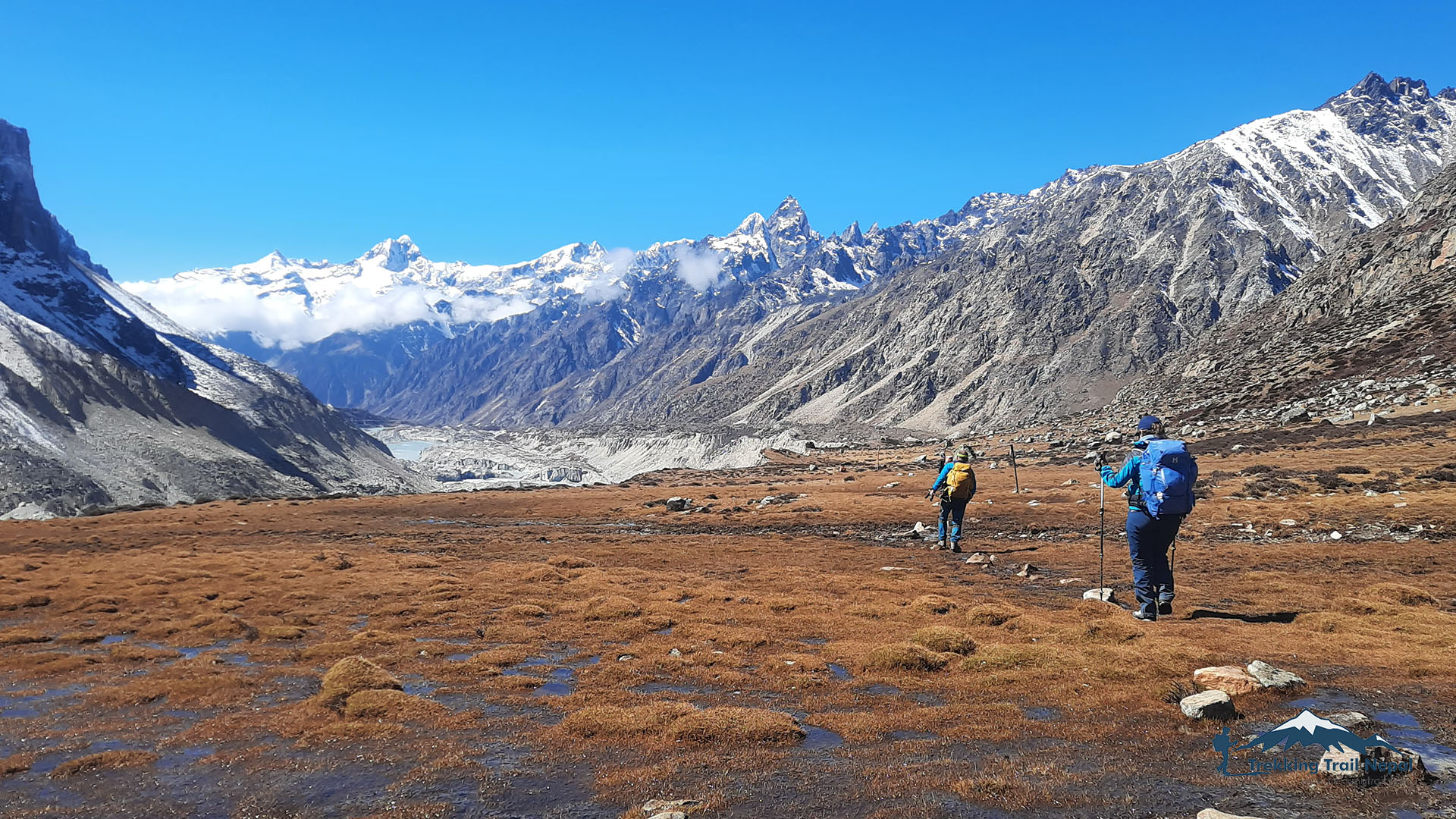
The Kanchenjunga Base Camp trek ends in front of the world’s third-highest mountain: 8,586 meters of rock. The ice that local communities call Kang Chen Dzo Nga, the Five Treasures of the Great Snows.
It is in far eastern Nepal, on the border with Sikkim, well away from the crowds of Everest and Annapurna. It is also one of the few big-mountain treks where you can choose, or combine, two very different base camps.
This guide compares the North and South base camps, walks through Trekking Trail Nepal’s 19-day route, and explains permits, difficulty and the best season in plain terms.
We will not give false information, as this trek is a strenuous, remote trek with basic teahouses and few places to restock. If that sounds like your kind of adventure, read on, then see our full Kanchenjunga Base Camp Trek page.
What Is the Kanchenjunga Base Camp Trek? Two Base Camps on One Remote Trail
The Kanchenjunga Base Camp trek is a 19-day journey from Kathmandu to the far east of Nepal, through Taplejung and the Kanchenjunga Conservation Area. Our trip page grades it as strenuous and the highest point is Pangpema, at 5,143m.
Along the way, you pass bamboo and rhododendron forests, alpine meadows, and glacial moraine. You will also get to meet Limbu, Rai, Sherpa and Tibetan communities in isolated villages.
This mountain has a long story. The British botanist Joseph Hooker explored this area between 1848 and 1849, collecting plants for his research. The trail opened to trekkers only in 1988, and it is still one of Nepal’s quietest big-mountain routes.
Kanchenjunga North vs South Base Camp: 7 Differences at a Glance
North Base Camp (Pangpema, 5,143m) is higher, colder, and wilder. South Base Camp (Oktang, 4,730m) is lower, greener and a little kinder.
Here is how they compare:
|
|
North Base Camp |
South Base Camp |
|
Altitude |
Pangpema, 5,143m |
Oktang, 4,730m |
|
What you see |
The massive north face of Kanchenjunga |
The south face, with Yalung Kang and Jannu |
|
Villages on the way |
Ghunsa, Khambachen and Lhonak |
Tseram and Ramche |
|
Terrain |
Glacial moraine, high and cold |
Lower rhododendron forest and Limbu and Rai villages |
|
Days on our trip page |
16–18 for the North only |
14–16 for the South only |
|
Difficulty |
Harder |
Easier, but still strenuous |
|
Best for |
Experienced trekkers who want wilderness |
Fit trekkers who want forests, culture and a shorter plan |
Can you do both?
Yes. The full circuit joins the two sides by crossing a high pass, listed at 4,480–4,640m on our page. It takes 22 days or more and demands better fitness.
To choose, ask yourself three questions:
- How many days can you spare?
- How comfortable are you above 4,500m?
- Do you want the raw north face or the greener south side?
Kanchenjunga Trek Itinerary: Trekking Trail Nepal’s 19-Day Route at a Glance
Days 5 to 16 are the actual trekking days. The rest is travel, rest or sightseeing.
Here is the route at a glance:
- Day 1: Arrive in Kathmandu and stay overnight in the capital city of Nepal.
- Day 2: You’ll get to explore Patan and Boudhanath sightseeing, our team will do the trek briefing and spend overnight in Kathmandu.
- Day 3: Fly to Bhadrapur (45 min), drive to Ilam Bazaar (about 5 hrs) and stay overnight in Ilam Bazaar.
- Day 4: Drive to Sekathum (8–9 hrs) and stay overnight in Sekathum.
- Day 5: Trek to Amjilasa (5–6 hrs) and spend the night in Amjilasa.
- Day 6: Trek to Gyabla (5 hrs) and sleep in Gyabla.
- Day 7: Trek to Ghunsa (5–6 hrs) and spend the night in Ghunsa (about 3,595m).
- Day 8: Acclimatisation day with an overnight stay in Ghunsa.
- Day 9: Trek to Khamnachhen (5–6 hrs) and an overnight in Khamnachhen (about 4,050m).
- Day 10: Trek to Lhonak (5–6 hrs) and rest in Lhonak (about 4,780m).
- Day 11: Trek to Ghunsa (7–8 hrs) and stay overnight in Ghunsa.
- Day 12: Trek to Selele Camp (4–5 hrs) and sleep overnight in Selele Camp.
- Day 13: Over Selele Pass to Tseram (8–9 hrs) and live in Tseram (about 3,870m).
- Day 14: Trek to Ramche, visit the Oktang viewpoint and return (6–7 hrs) back for an overnight stay.
- Day 15: Trek to Tortong (6–7 hrs) and spend the night in Tortong.
- Day 16: Trek to Ranipul, also called Hellok (8–9 hrs) and rest for the night in Ranipul.
- Day 17: Drive to Kanyam, Ilam and stay in Ilam for the night.
- Day 18: Drive to Bhadrapur, fly to Kathmandu.
- Day 19: Airport transfer.
Day 14 is your South Base Camp day, at the Oktang viewpoint. Lhonak on Day 10 is the usual launch point for Pangpema, so ask the team how North Base Camp fits your dates.
How Hard Is the Kanchenjunga Base Camp Trek?
The Kanchenjunga Base Camp trek is strenuous, and our trip page rates it harder than the Everest Base Camp Trek or Manaslu.
Five things make it hard:
- Long days: Most walking days run 5 to 9 hours.
- Long drives: Two road days at the start add up to about 13–14 hours.
- Basic facilities: Teahouses are simple, with twin beds and shared bathrooms.
- Remoteness: Trails are not well defined, and you have little chance to restock.
- Altitude and passes: You spend days above 4,000m and cross a high pass.
We do not recommend the full trek for absolute beginners. A fit novice with good walking experience can manage the shorter South route.
Your guides carry first-aid kits and monitor oxygen saturation daily. To see how we grade each route, read our Trekking Grade guide.
Altitude and Acclimatization on the Kanchenjunga Trail
Day 8 at Ghunsa is your acclimatization day. Use it to rest, not to explore.
Tell your guide at once about headaches, nausea or dizziness, because these are early signs of altitude sickness. Our Altitude Sickness Preventions Treatments page explains what to watch for.
Kanchenjunga Trek Permits and Rules for 2026-2027
You need two permits for this trek:
- Restricted Area Permit (RAP): USD 20 per week for the first four weeks.
- Kanchenjunga Conservation Area Permit (KCAP): NPR 3,000 on our trip page. We confirm the latest rate at booking.
A licensed guide through a registered agency is mandatory, and independent trekking is not allowed.
Since March 2026, the old two-trekker minimum has been dropped, so single travellers can apply with a guide.
Best Time for the Kanchenjunga Base Camp Trek
The best months are March to May and October to November.
Spring brings blooming rhododendron and orchid forests and warmer days. During Autumn, you’ll get to see crystal-clear views and stable weather after the monsoon.
Winter is very cold above Lhonak, and monsoon rain brings landslides on the road sections. See our Best Season For Trekking in Nepal guide for more.
What Trekking Trail Nepal’s Kanchenjunga Package Includes and What Costs Extra
Trekking Trail Nepal has 11 years of experience and is a member of the Trekking Agencies’ Association of Nepal (TAAN). With effective and real-life applied trekking practices, we have zero rescues and a 100% success rate.
Here is what our package covers:
- Private airport and hotel transfers
- The round-trip flight to Bhadrapur
- Hotel nights in Kathmandu with breakfast
- A licensed guide trained in Wilderness First Aid and altitude sickness
- One porter for every two trekkers
- Three meals a day on the trek, with tea or coffee
- A group first-aid kit
These cost extra:
- Lunch and dinner in Kathmandu
- Your Nepal visa (available on arrival)
- International flights
- Drinks, hot and cold showers
- Personal expenses such as internet, laundry and charging, personal trekking gear and tips.
Pricing depends on group size, from one trekker to twelve.
Final Verdict: Which Kanchenjunga Base Camp Is Right for You?
Choose South Base Camp if you want forests, villages and a shorter plan. Choose North Base Camp if you are experienced and want the high, wild side. You can also choose the full circuit if you have the days and the fitness for both.
Whichever you pick, the Kanchenjunga Base Camp trek rewards preparation. Start with our Kanchenjunga Base Camp Trek page.
Frequently Asked Questions
Is there mobile signal, Wi-Fi or charging on the trail?
Signal is close to zero for most of the route. Carry a power bank and spare batteries. Charging is possible at some teahouses, but it costs extra.
Is the Kanchenjunga trek safe for solo female travellers?
It is a guided trek on quiet trails, and your guide stays with you. Rooms are basic and shared bathrooms are common. Tell us your preferences when you inquire, and we will plan around them.
Can I see red pandas on the trek?
Our trip page calls the red panda the jewel of the region. Sightings are never guaranteed. Our trip page also recommends a visit to the Red Panda Centre in Taplejung.
What should my travel insurance cover?
It must cover emergency evacuation to about 5,500 m. We do not sell insurance. Read our Nepal Travel Insurance guide before you buy.
Can I add Ilam tea gardens or other extensions?
Yes. We can add extra days before or after the trek, such as time in Ilam’s tea gardens. Use our Personalize Trip page to share your ideas.
How much cash should I carry?
Carry Nepali rupees for drinks, charging, showers, and tips. There are no ATMs on the trail, so withdraw cash in Kathmandu or Ilam before you trek.
What if my Bhadrapur flight is cancelled?
Weather can delay or cancel flights in eastern Nepal. That’s why we suggest keeping some buffer time in your plans.
Comments (0)